Buy Yes No Maybe Book
Category

Employee Engagement

Employee Engagement

Five Career Lessons from The Wizard of Oz

[This guest post was written by Sybil F. Stershic, president of Quality Service Marketing. Sybil has extensive experience helping service-based organizations and nonprofits strengthen employee and customer relationships. A respected thought leader on engaging employees with internal marketing, she is the author of several books and the long-running Quality Service Marketing blog.]

Five Career Lessons from The Wizard of Oz

One of my favorite childhood films, The Wizard of Oz, offers many wonderful life lessons.  As a devotee of professional development as well as the film, here are several of my favorite career take-aways from Oz.


  1. Seeking Your Dream Job in the Emerald City
    While the term “career path” implies a straight line to a destination dream job, the reality is stuff happens — like avoiding a bad witch with a minion of flying monkeys — that makes the path curve in unexpected directions.

To survive, you’ll need to carefully navigate a series of twists and turns that involve obstacles to be overcome and opportunities for self-discovery. As Dorothy Gale learned, it’s an incredible adventure that’s best shared with people you trust.

  1. The Good Witch or Bad Witch School of Management
    While at some point we’re likely to work for an Elvira Gulch-like clone, wouldn’t it be great to have Glinda the Good Witch watching out for us on the job? Along with that wishful thinking, many people naively presume that everyone in a position of authority is competent and capable of leading and/or managing effectively.

Sadly, not every manager is skilled at communicating and working well with others, and keeping a bucket of water nearby won’t remedy the situation. In addition to bad bosses, there are managers who feel they have to “hide behind the curtain” to be perceived as power players. Nonetheless, it’s important to respect even those self-proclaimed Wizards’ position and authority level, even if you don’t respect them personally.

  1. The Path to Wisdom
    The Scarecrow’s journey may have ended with being awarded an official degree, but there’s no end to seeking knowledge. On-the-job training and continual learning (e.g.,  reading, networking, personal and professional development, etc.) are just as important as formal education.
  2. Courage in Your Endeavors
    Despite the Lion’s false bravado, you can’t lead when you’re paralyzed by fear of failure. “Fake it til you make it” isn’t an effective strategy for the King of the Jungle or anyone in a position of power. As Conan O’Brien acknowledged, “[Don’t] be afraid to fail … whether you fear it or not, disappointment will come. The beauty is that through disappointment you can gain clarity, and with clarity comes conviction …”
  3. Heart – a Key to Success
    As the Tin Man would learn, “Do work with your whole heart and you will succeed — there is so little competition.” – Elbert Hubbard

    And one other quote from Conan O’Brien that relates to Dorothy, Scarecrow, Tin Man, and the Lion on their fantastic journey:  ”Work hard, be kind, and amazing things will happen.”

Your turn
There are many more film-related lessons that are applicable to the workplace, and I welcome you to share your favorites.

[Photo source: http://www.fanpop.com/clubs/the-wizard-of-oz/images/35086966/title/ruby-red-slippers-ii-wallpaper]


Change Careers, Employee Engagement

Honest Career Discussions are Scary for Managers and Employees

Clients come to me because they are thinking of changing careers, are unhappy in their position, or want to grow and develop in their current company. I’m often their first stop for this discussion. In a perfect world, managers everywhere would know how to facilitate career development conversations and employees would be confident that having a real career discussion inside the organization wouldn’t have a negative impact. But we’re not there yet.

Who is responsible?

Is it the manager’s job to give employees all the answers for evolving in their career? No. The heavy lifting has to be done by the employee. But here’s the question:

How do we inspire employees to “drive their own career car” if we can’t support the message internally?

If full-on career conversations are not embraced internally, people come to career coaches where the certainty of anonymity and confidentiality allow a full exploration of options (including staying within their current organization) without jeopardizing their current role.

Hiding from the career development discussion doesn’t help.

After attending a SHRM workshop this summer about employee engagement and career development, I spoke with HR managers who confirmed the challenge of honest career conversations. It’s a fact that some organizations have departments where employees would never talk honestly with the manager for fear it would make life in their current role intolerable. And, sometimes, it’s because managers haven’t been introduced to the coaching skills required to navigate that type of conversation.

As I implement programs that inspire employees to slide into the driver’s seat, I also challenge companies to explore a confidential career resource for employees until internal career dialogues are fully embraced. If your organization has adopted an approach that works, I’d love to hear your comments.

As you plan for more holistic support of your team in 2017, consider making career coaching available to drive engagement from the employee side. Career Wellness Partners can help – ask me how!

Image courtesy of Pexels.com

Employee Engagement, Mid Life Professionals

Active Questions to Energize Your Career

What does it mean for an employee to do “their part ” when it comes to finding career fulfillment?

I read Marshall Goldsmith’s book, Triggers, and the conversation he had with his daughter, Dr. Kelly Goldsmith, Assistant Professor of Marketing at Northwestern’s Kellogg School of Management, about active questions resonated with me. It affected me so much that Coach Goldsmith and I had a phone conversation about it over the summer.

The concept of ownership is at the very core of my career coaching practice. Meaning, I work with clients who no longer want to sit on the sidelines while work happens to them. Instead, they want to take responsibility for their own career development. They are done handing that control over to someone else while hoping for the best.

Coach Goldsmith and I share the frustration with employee engagement conversations that, until now, have been almost entirely one-sided. Consultants and thought leaders focused on helping companies build engaged workplaces continue to focus squarely on the employer side, and regularly preach about what employers should do to improve their employees’ desire to engage while at work. But there is an entire half of the conversation that is missing here. My purpose, as a coach, is to motivate and inspire employees to do their part to balance the scales. It is entirely possible to be truly engaged in your job without depending on your employer to get you there. Much of it depends upon your outlook.

So we come back to the question: What does it mean for an employee to do “their part ” when it comes to finding career fulfillment? That’s where active questions come in. Questions like Goldsmith shares in his book puts the onus on the employee. Questions like:

  • Did I do my best to find meaning today?
  • Did I do my best to be happy today?
  • Did I do my best to build positive relationships today?
  • Did I do my best to be fully engaged today?

Employees cannot sit with a victim mindset when asking themselves these questions. When I find that a client cannot shift out of victim mode, I know that coaching isn’t what they want; they want someone to hand them answers. People who are truly looking for career wellness, achieving the optimal state of work wellbeing at any given time, must decide to figure out how to use their strengths and skills in a meaningful way. To succeed on this journey, you must have goals but not a fixed expectation of the outcome. You must be open to experimenting. The employees who have this exploration mindset are the ones who will step up their level of engagement for your company while they’re sorting things out for themselves. They will hold themselves accountable – not rely on you for all of the answers.

To get there, they must be actively seeking. Actively questioning. Actively engaged for their own reasons.

Want more great insights championing the employee side of employee engagement? Want to spark your own career fulfillment fire? Sign up to get posts delivered directly to your email.

Image courtesy of Pixabay.com

Employee Engagement

What Employees Need To Know About Employee Engagement

There’s a lot of talk about employee engagement out there, but as an employee, remember these things:

No matter what your company does, it’s all up to you.

It’s your company’s job to set the stage for engagement and to create a culture that pushes all of the engagement hot buttons: relevance, a sense of autonomy, growth, meaning, etc. That’s their job. They can set it all up, but you have to want it for yourself.

Companies can lead an employee to engagement but….

They can’t make you drink their Kool-Aid, right? Why would you want to anyway? Your job is to make a recipe for your own Kool-Aid and contribute to the company you’re with while tweaking your own ingredients. Instead of disengaging because you’re not feeling the vibe where you are, engage for the purpose of finding out where you should be instead.

Become your own career coach.

Use the opportunities the company gives you for your personal career development plan. You may have other goals than staying where you are. That’s fine – but don’t be a victim while you’re there. Make every company-sponsored perk an opportunity to analyze your strengths and interests. Take advantage of any assessments your company offers. Consider it free coaching! Only you have to know why you’re engaging. Instead of being skeptical about their manipulative tactics to get you to perform, perform for your own benefit. The company still wins, but you win too. Take what you learn to move within your existing organization if you can or on to your ideal role somewhere else. Just don’t sit on the sidelines and complain.

Yes, it’s all about their bottom line.

What about your bottom line? The company is doing their job. What are you doing? If you are sitting around waiting for the right perk to make you happy, you’re part of the problem. Companies have poured years of research and time and money into figuring out why engagement numbers aren’t what they want. What have you done for yourself to take accountability for your career wellness? Engagement is good for all, so be the manager of your own career and make your bottom line just as valuable. Think employee engagement is only for managers and executives? It’s really about you. You just haven’t been informed of how to use it yet.  Keep reading to learn more.     photo credit: Rochester Memorial Art Gallery, Rochester, NY via photopin (license)
Employee Engagement

The BIG Mistake Companies Are Making in Employee Engagement Programs

Many business decision makers have intentionally stuck their head in the sand when it comes to employee engagement. They have been talking about it for years now. Engagement equals higher productivity and blah, blah, blah. Yes, those numbers are real, and Gallup gives us the evidence:

“Work units in the top quartile in employee engagement outperformed bottom-quartile units by 10% on customer ratings, 22% in profitability, and 21% in productivity. Work units in the top quartile also saw significantly lower turnover (25% in high-turnover organizations, 65% in low-turnover organizations), shrinkage (28%), and absenteeism (37%) and fewer safety incidents (48%), patient safety incidents (41%), and quality defects (41%).”

But what isn’t being talked about is the reason so many companies fail in building engaged workforces.

Companies looking to improve  employee engagement numbers won’t get the figures they want until the employee side of the conversation opens up. Not until we tackle the other part of the equation will the numbers reflect what the company side is hoping to achieve. Companies need to dip their toes in the soft and scary side of this issue. “It reeks of counseling or therapy,” an executive said to me. Yeah, you betcha, it does. So what? If your goal is to make your company workforce more effective, more productive, and more profitable, are you going to shy away from doing what works because it’s too touchy-feely?

I’m being paid by employees all over the country to help them figure out why they aren’t happy in companies where, by all appearances, they should be. We have to reach the employees who think that something external is the answer.

By the way, helping them sort out their internal career clutter doesn’t always mean they’ll leave. Accepting personal responsibility for career wellness creates freedom for employees at all levels to engage for reasons they haven’t before. Millennials are already sparking change in the way we think about career coaching as reported in this article and this one. Newsflash, it’s not only millennials who need it.  

For anyone leading a company that cares about culture and understands how vital it is to success, the next step is opening up to the “soft” side. Coach the employee side, the personal side, of employee engagement, complete the equation and who knows, companies just may begin to see the ROI they’ve been trying to see for the past 30 years.

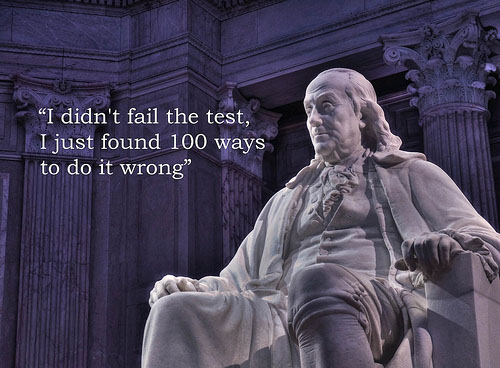
Photo credit: Ben Franklin Quote – Failing 100 Ways via photopin (license).

Privacy Settings
We use cookies to enhance your experience while using our website. If you are using our Services via a browser you can restrict, block or remove cookies through your web browser settings. We also use content and scripts from third parties that may use tracking technologies. You can selectively provide your consent below to allow such third party embeds. For complete information about the cookies we use, data we collect and how we process them, please check our Privacy Policy
Youtube
Consent to display content from - Youtube
Vimeo
Consent to display content from - Vimeo
Google Maps
Consent to display content from - Google
Spotify
Consent to display content from - Spotify
Sound Cloud
Consent to display content from - Sound
Cart Overview